Promoting Breast Cancer Awareness in Kenya and Africa: A Call to Action
- Dr. Fedinand Getankwa

- Nov 18, 2024
- 4 min read
I have lost four relatives in a span of 1 month, they all had cancer. Two of them had breast cancer. In my country Kenya, we find that some of the reasons why the breast cancer case fatality is rising is due to the low awareness with only 36% of people feeling that cancer is a major health issue. People lack adequate information on the need to undergo screening for breast cancer. As a result, we often see many patients come to the clinics when their disease is too advanced.
It is time for all of us—men and women alike—to better understand breast cancer to protect our loved ones and communities. This article seeks to inform and educate you about breast cancer, which continues to claim the lives of our daughters, wives, and mothers. If we can be more vigilant about breast cancer and catch it early on, we can save more lives because when caught early, breast cancer is treatable and manageable.
Kenyan Situation
Breast cancer leads the way in the incidence of cancer cases in Kenya with 6799 each year and comes second in the mortality rate with 3107 deaths annually.
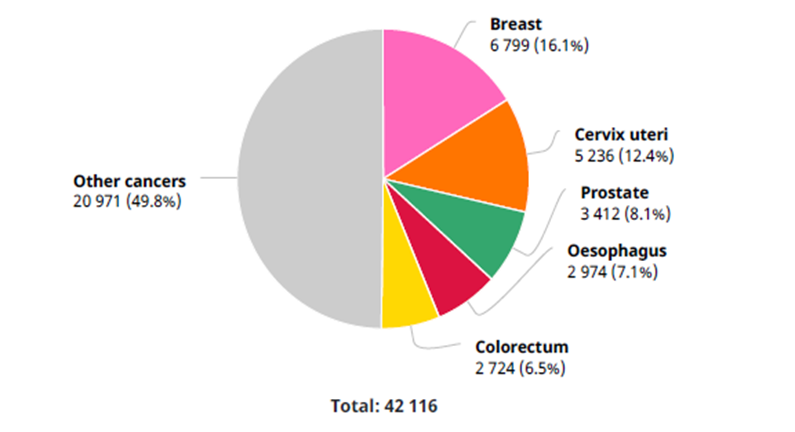
Image Courtesy: Ministry of Health, Kenya
Risk Factors for Breast Cancer
Being female
Aging – as you get older in the latter 40s and more incidence in your 50s and 60s.
Smoking cigarettes
Overweight and obesity- target a healthy body mass index (BMI) of 18.5-2 kg/m2
Family history- having close relatives with breast cancer increases your risk of developing it too.
Exposure to radiation- such as having excessive CT scans and chest X-ray irradiations in your lifetime.
Early start of menses (i.e., before 11 years)
Later menopause – above 55 years and still having menses
Using hormone replacement therapy
When to suspect it might be cancer?
If you feel a breast lump or thickening, often without pain.
The lump has been increasing in size
The breast has some dimpling

Change in size, shape or appearance of the breast and loss of breast symmetry.

Abnormal or bloody fluid from the nipple.


Dermatitis around the breast- but this one is non-itchy and does not spread further away from the nipple area.

Taking a Self-Breast Examination
I encourage you to do a monthly breast exam, usually 1 week after menses if you still experience menstrual periods. If you did it on the second week of November, wait until a similar time the following month to repeat it. I know this can vary especially if your menses is not 28 days, if that is the case, stick to doing it one week after the menses each month.
From attending to patients in the clinics, I have realized that a number of women have not been taught how to do a self-breast exam. I am going to guide you, so follow closely these steps below:
1. While in the shower, use your middle three fingers- the index, middle and ring fingers- and press against the left breast moving in a full circle. Begin with light and increase to firm pressure. Feel for any lumps in the breast. Proceed to the armpit on the same side and feel for any thickenings or hardened knots. Repeat this for the right breast.
2. In front of a mirror, with arms stretched to the sides, look at your breasts for any new abnormalities in appearance. Do they look fairly equally sized and shaped? Are there any skin irregularities, such as a dimpling around the nipple or a change in coloration of the skin around the nipple area?
3. Now take your arms and squeeze the nipple for each breast lightly. Is there fluid coming out with ease? Pressing too hard may cause some fluid to come out, this is normal.
If you detect any new lumps, abnormal skin changes of the breast, or oozing from the nipple, it is important to see a doctor for further examination and screening for breast cancer.
Screening Methods
We can now detect breast cancer early through screening. The aim of screening is to increase the detection of breast cancer in its early stages. Detecting breast cancer early can reduce mortality by as much as 35%.
We advise women between age 40 and 74 years to have screening for breast cancer every 1-3 years.
Women in special categories, such as those with a first-degree relative (your parent or sibling) with breast cancer should have their screening begin as early as 10 years before that relative had it. For instance, if your mother got diagnosed with breast cancer at 42 years, you will begin your screening at 32 years.
Women who had previous breast cancer on one side that was successfully treated should undergo screening for the other breast every 6-12 months.
Summary
© Tell someone to tell someone: early detection and vigilance can save lives, as breast cancer is treatable when caught early.
© Visit a doctor if you suspect something abnormal in your breast.
© Do a self-breast exam monthly, 7 days after menses.
© Women aged 40-74 should be screened every 1-3 years.
© High-risk women (e.g., with a first-degree relative with breast cancer) should begin screening 10 years before the age of diagnosis of the relative.
© Women with prior breast cancer should screen the other breast every 6-12 months.


Comments